Michaela’s Diabetes
Wann wird es endlich wieder so, wie es nie warMichaela’s diabetes is presented as a serious, continuing condition that shapes her childhood, places her at acute risk when snow cuts off her household, and remains part of her life after that household is broken up. Her story moves from difficult encounters with the narrator to a rescue that depends on her father’s medical intervention, and ends with her living on while blind from the disease.
Identity and Early Experience
Michaela is the narrator’s contemporary in age and the daughter in a sibling household. She has severe diabetes and poor eyesight from the time the narrator first knows her; during the day, she attends a special school. Their acquaintance is marked by hostility rather than companionship: she behaves aggressively toward the narrator and threatens him with her insulin syringe and a garden chemical. The narrator explicitly says that this did not develop into a friendship, distinguishing their proximity as children from any genuine bond.
Insulin Crisis During the Snow Disaster
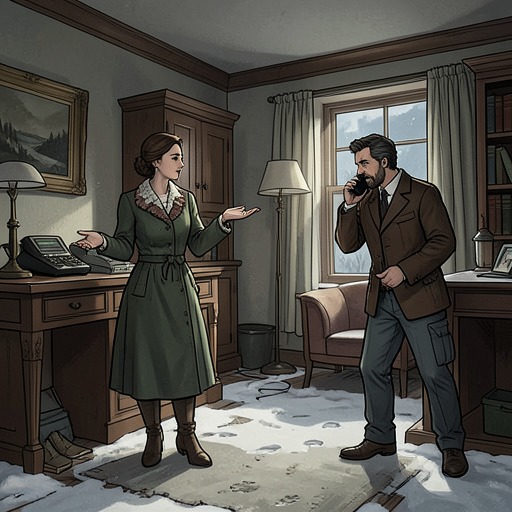
During the 1978–1979 North German Snow Disaster, Michaela and her brother become cut off from the outside world. Her brother phones the narrator’s father for help. With Michaela out of insulin, confused, and unable to get up, her condition becomes life-threatening. The father tries to reach the hospital and the police, but telephone lines are occupied or leave him waiting; the isolation that prevents ordinary assistance makes her diabetes an immediate emergency.
A helicopter eventually reaches the household. In a television report watched by the narrator’s family, the father enters the home with Michaela’s brother. The power is out, and candles provide the only light. Michaela is exhausted on the sofa. The father gives her insulin, and she and her brother are later flown to an emergency shelter. The episode makes the practical stakes of her illness explicit: without access to insulin and outside help, she is in danger; rescue brings both medical intervention and evacuation from the isolated home.
Household Dispersal and Later Life
The narrator believes that his father subsequently arranged for the Meisner siblings’ household to be dissolved. Michaela’s brother received an apartment in the city, while Michaela was placed in an institution. The account does not establish the details of her care there, but the change marks a lasting separation from the household in which the emergency took place.
Her diabetes later causes her to lose her sight. She is still alive at the time of the narrator’s retrospective account, while the house where the siblings had lived has fallen into disrepair. The ending thus separates Michaela’s continued life from the decline of the place associated with her earlier circumstances.
Narrative Significance
Michaela’s illness is not treated as a single crisis that ends with the helicopter rescue. The narrative connects the everyday requirements of a chronic condition—especially continued access to insulin—with the consequences of isolation, emergency response, and subsequent changes in living arrangements. Her blindness and survival also give the account a longer horizon than the rescue scene: the immediate danger passes, but diabetes continues to shape her life.